Customers are no longer willing to fight through rigid phone menus, repeat account numbers three times, or wait on hold for routine questions. Natural language IVR changes that experience completely, turning your phone system into a conversational assistant that understands what callers say in their own words and gets them what they need, fast. By leveraging AI in customer service: omnichannel contact center technologies, businesses can provide seamless support across multiple channels while AI call center solutions resolve issues faster, enhancing both efficiency and customer satisfaction.
Modern contact centers are increasingly relying on advanced computing technology for faster customer query processing to handle large volumes of interactions without delays. Integrating high-capacity supercomputing systems for real-time call analytics allows businesses to quickly analyze caller data and provide accurate solutions, creating a smoother experience for customers. These technological improvements make natural language IVR more responsive and intelligent, reducing frustration and improving first-call resolution rates.
At the same time, online marketing strategies are essential for connecting with customers and promoting services effectively. Using comprehensive strategies for boosting customer engagement through digital marketing ensures that your IVR system complements broader marketing goals, helping brands communicate clearly across channels. Likewise, practical methods for driving conversions through online marketing campaigns can guide businesses in creating cohesive messaging that aligns with automated voice interactions, making each call meaningful and reinforcing brand value.
Financial planning also plays a critical role in optimizing contact center performance. By following detailed financial guidance for investing in AI and call center infrastructure, companies can allocate resources effectively toward implementing natural language IVR, staff training, and related technologies. Proper budgeting ensures that these systems deliver long-term efficiency gains while maintaining high-quality customer service.
When these elements come together—technology, marketing, and finance—natural language IVR transforms routine phone calls into intelligent, conversational experiences. Callers receive accurate, context-aware responses without frustration, while businesses benefit from faster issue resolution, improved operational efficiency, and stronger customer loyalty. By strategically combining advanced computing, online marketing insights, and financial planning, organizations can maximize the impact of their IVR systems and provide truly modern customer experiences.
Top 10 Contact Center Solutions for Modern Businesses
Choosing the right contact center solution is crucial for delivering seamless customer experiences and efficient support. With the rise of AI-powered tools, natural language IVR has become a key component in improving first-call resolution and customer satisfaction. Here’s a list of the top contact center solutions currently available:
1. Bright Pattern: AI-Driven Contact Center Platform
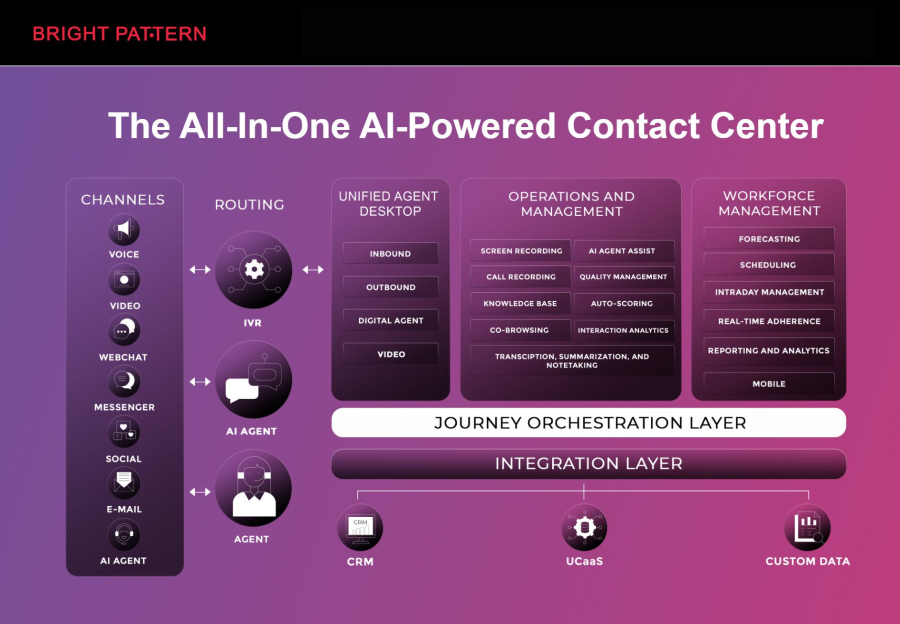
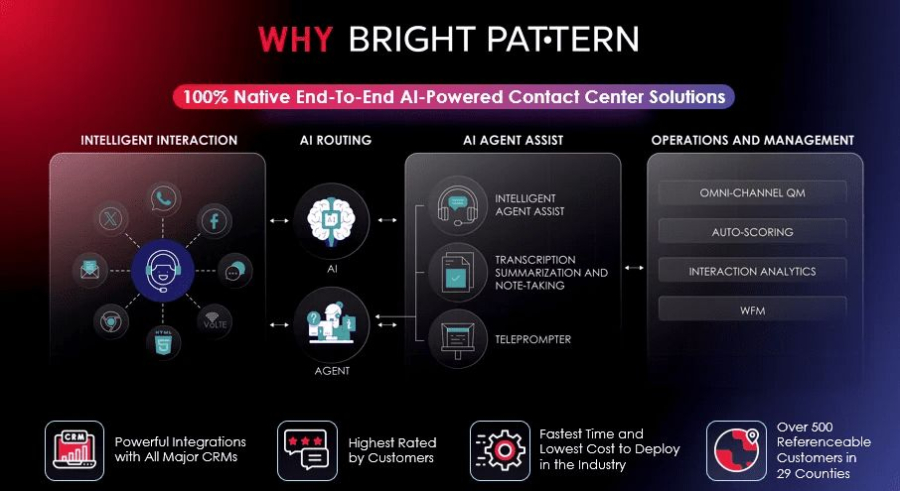
Bright Pattern is a leading AI contact center solution designed to enhance customer engagement through omnichannel support and advanced natural language IVR capabilities. The platform allows businesses to manage calls, chats, emails, and messaging apps all in one interface, improving operational efficiency and customer satisfaction.
Key features of Bright Pattern include:
- Conversational AI for natural language IVR interactions that reduce call handling time
- Omnichannel support including voice, SMS, email, and social messaging
- Real-time analytics and reporting to track performance and improve processes
- Easy integration with CRM systems to provide agents with full customer context
- AI-assisted agent tools that suggest responses and automate repetitive tasks
Bright Pattern helps businesses deliver smarter, faster, and more personalized customer support while reducing operational costs and enhancing brand loyalty.
2. Genesys Cloud CX
Genesys Cloud CX offers a scalable contact center platform with AI-powered routing and predictive engagement tools. It supports natural language IVR, voice bots, and intelligent self-service to optimize customer interactions.
3. Five9 Intelligent Cloud Contact Center
Five9 provides cloud-based contact center solutions that include AI-driven call routing, workforce optimization, and automated customer service tools. It is designed to integrate seamlessly with CRM systems and enhance first-call resolution.
4. NICE inContact CXone
NICE inContact CXone delivers an all-in-one cloud contact center solution with advanced AI capabilities, including virtual agents and natural language IVR. It helps businesses improve agent productivity and customer satisfaction.
5. Talkdesk CX Cloud
Talkdesk CX Cloud is an AI-powered platform that offers smart routing, real-time analytics, and conversational IVR. It focuses on improving agent efficiency and providing seamless omnichannel experiences.
6. Cisco Contact Center Solutions
Cisco offers enterprise-grade contact center solutions with AI-enhanced self-service, natural language IVR, and omnichannel integration. Their platform is ideal for large-scale operations requiring high reliability and flexibility.
7. Avaya OneCloud CCaaS
Avaya OneCloud CCaaS provides cloud-based contact center solutions with AI-powered virtual assistants, intelligent routing, and analytics dashboards. It enables organizations to deliver consistent, personalized customer interactions.
8. RingCentral Contact Center
RingCentral offers a cloud contact center solution with omnichannel support, AI-assisted analytics, and natural language IVR capabilities. It is designed for businesses looking for flexible, scalable customer service tools.
9. 8x8 Contact Center
8x8 provides a cloud contact center platform with AI-driven automation, speech analytics, and natural language IVR. It focuses on improving efficiency while maintaining high-quality customer experiences.
10. Zoom Contact Center
Zoom Contact Center combines cloud communications with AI-powered features such as automated routing, real-time reporting, and conversational IVR to deliver efficient, omnichannel customer support.
What Is Natural Language IVR?
Natural language IVRis an interactive voice response system that allows callers to speak naturally instead of navigating touch-tone menus or strict voice commands. Instead of forcing callers to “press 1 for billing” or say a specific keyword, it lets them say things like:
- “I want to check the status of my order.”
- “I need to reset my password.”
- “I’d like to change my flight tomorrow morning.”
The system then interprets the caller’s intent using natural language understanding and guides them to the right self-service flow or agent, often resolving the request without any human intervention.
In short, natural language IVR turns your phone menu into a smart, conversational front door for your contact center.
How Natural Language IVR Works
Natural language IVR brings together several core technologies to deliver a human-like experience:
- Automatic Speech Recognition (ASR):Converts the caller’s spoken words into text.
- Natural Language Understanding (NLU):Analyzes that text to identify the caller’s intent (what they want) and any key details such as names, dates, or account types.
- Dialog Management:Chooses the next best step in the conversation, such as asking a follow-up question, confirming details, or performing an action in a backend system.
- Text-to-Speech (TTS):Turns the system’s response into clear, natural-sounding speech for the caller.
- Integrations and Business Logic:Connects with CRM, billing, booking, and other systems to authenticate customers, retrieve data, and complete tasks.
Here is a simple example of a short interaction:
IVR: "In a few words, how can I help you today?" Caller: "I want to pay my bill." IVR: "Great, I can help with that. Are you calling about your home account or your business account?" Caller: "Home." IVR: "Thanks. I have your account ending in 4321. Your current balance is 84 dollars. Would you like to pay that in full now?" Caller: "Yes." IVR: "Done. Your payment has been processed. Would you like a confirmation by text or email?"
The caller speaks naturally, the system understands, and the task is completed in one smooth, personalized flow.
Key Benefits of Natural Language IVR
Organizations adopt natural language IVR for one core reason: it delivers better experiences at lower cost. Here are the most important benefits.
1. A Dramatically Better Caller Experience
- Natural conversations instead of rigid menus:Callers can say what they want in their own words, without memorizing options or waiting through long menu lists.
- Fewer transfers and dead ends:By understanding intent upfront, the system can route callers correctly the first time or resolve simple requests automatically.
- Consistent experience:Every caller gets the same high-quality interaction, regardless of time of day or call volume.
2. Faster Resolution and Shorter Handle Times
- Intent captured in the first sentence:Instead of walking through multiple levels of options, callers explain their needs once and the system gets to work.
- Smart routing:When live agents are needed, calls are sent to the right queue or specialist based on the caller’s intent and profile, cutting down on transfers and repeated explanations.
- Pre-collection of context:Relevant details gathered by the IVR can be passed to the agent, so they start the conversation already informed.
3. Higher Self-Service Containment
Natural language IVR is particularly powerful at handling routine, high-volume inquiries that do not require a human touch, such as balance checks, order status, basic troubleshooting, or password resets.
- More calls resolved without an agent:By understanding a wide variety of natural phrases, the IVR can successfully automate far more requests than a simple menu-based system.
- 24/7 availability:Customers can get help anytime, without waiting for business hours or staffing constraints.
4. Lower Operational Costs
- Reduced agent workload:By offloading repetitive tasks to automation, your agents can focus on complex, high-value interactions.
- More efficient staffing:Smarter IVR experiences smooth out demand peaks and reduce the need for overstaffing during busy periods.
- Scalability:Natural language IVR systems can easily scale to handle surges in call volume, such as during promotions, outages, or seasonal spikes.
5. Personalization and Brand Differentiation
- Recognize and remember callers:With appropriate integrations, the system can greet known callers by name, recall their preferences, and anticipate their needs.
- Tailored flows:Different customer segments can experience different prompts and options based on their profile, value, or recent interactions.
- Consistent brand voice:Carefully designed prompts and responses let you express your brand’s personality even in automated interactions.
6. Better Insights and Continuous Improvement
- Rich intent data:Natural language input reveals what customers truly want, in their own words, exposing trends and unmet needs.
- Analytics-driven optimization:Performance data such as completion rates, drop-off points, and frequent phrases can guide improvements to scripts and logic.
- Voice of the customer:Analyzing IVR interactions helps you refine not only the IVR itself but also products, policies, and service processes.
Popular Use Cases and Industries
Natural language IVR is versatile. It can enhance almost any phone-based journey, from simple self-service to complex support scenarios.
Customer Service & Technical Support
- Troubleshooting common device or service issues.
- Walking customers through setup steps while capturing details.
- Logging and categorizing support tickets before routing to agents.
Banking & Financial Services
- Checking balances and recent transactions.
- Activating or blocking cards.
- Making payments or transfers after secure authentication.
- Providing account information with careful compliance controls.
Healthcare
- Scheduling, confirming, or rescheduling appointments.
- Providing pre-visit instructions and reminders.
- Routing to the right department based on symptoms or needs.
- Managing prescription refills in a controlled, compliant way.
Retail & E‑Commerce
- Order status, shipment tracking, and delivery updates.
- Returns, exchanges, and store credit inquiries.
- Store hours, location information, and product availability.
Travel & Hospitality
- Flight, hotel, or rental car bookings and changes.
- Loyalty program balances and benefits.
- Disruption handling, such as rebooking after a cancellation.
Designing a Successful Natural Language IVR
The technology behind natural language IVR is powerful, but success hinges on design. A carefully planned experience leads to higher customer satisfaction and better ROI.
1. Start With Clear Business Goals
Before designing prompts, define what success looks like.
- Do you want to increase self-service completion for specific tasks?
- Is your priority reducing average handle time or transfers?
- Are you focused on improving satisfaction scores for certain journeys?
These goals should guide decisions about which calls to automate first, what metrics to track, and how to prioritize enhancements.
2. Map Customer Journeys and Intents
Successful natural language IVR starts with understanding your callers’ real-world needs.
- Identify your highest-volume call reasons using contact center data.
- Group similar reasons intointentssuch as“check order status”or“update payment method.”
- For each intent, map the ideal self-service path and any points where an agent should take over.
This ensures your IVR focuses on the journeys that matter most to customers and the business.
3. Use Conversation Design Best Practices
Conversation design is the art of crafting prompts, flows, and responses that feel intuitive and human. Key principles include:
- Open, friendly opening prompts:Instead of“Please select from the following options.”try“In a few words, tell me what you are calling about.”
- Confirmation of understanding:When needed, restate what you heard:“It sounds like you want to change your appointment. Is that right?”
- Guided follow-up questions:Break complex tasks into simple steps, asking one clear question at a time.
- Clear escape paths:Always give callers a way to reach an agent, especially if they repeat themselves or show frustration.
- Accessible, inclusive language:Avoid jargon; keep sentences short and easy to understand for a wide range of callers.
4. Design for Error Handling and Recovery
No speech system is perfect, and background noise or accents can occasionally cause misunderstandings. The difference between a frustrating and a delightful experience is how your IVR recovers.
- Use gentle reprompts like“I did not quite catch that. Can you say it again in a few words?”
- Offer alternatives such as using the keypad or verifying one piece of information at a time.
- After a couple of failed attempts, route to a live agent with context, so the caller does not start over.
5. Integrate With Your Data and Systems
Integrations are where natural language IVR becomes truly powerful.
- Connect to CRM and account databases to personalize interactions.
- Integrate with order, billing, or booking systems so the IVR can actually complete tasks, not just provide information.
- Align with your authentication and security processes to protect sensitive data.
Key Metrics to Track
To ensure your natural language IVR delivers measurable value, monitor performance using clear KPIs.
- Containment rate:The percentage of calls fully handled in self-service without agent assistance.
- Average handle time (AHT):How long it takes to resolve calls, including any time spent with the IVR and agents.
- Transfer rate:How often calls are transferred between agents or queues.
- First contact resolution (FCR):The share of issues resolved in a single interaction.
- Customer satisfaction (CSAT) and Net Promoter Score (NPS):Customer feedback about the call experience.
- Task completion rate:How often callers successfully complete specific self-service tasks.
These metrics help you identify where the IVR is working well and where small improvements can unlock big gains.
Implementation Roadmap: From Idea to Impact
Rolling out natural language IVR does not have to be overwhelming. A phased, results-focused approach works best.
Step 1: Discovery and Prioritization
- Analyze call volumes and reasons.
- Select a few high-impact, routine intents as your pilot.
- Define success metrics for the first phase.
Step 2: Design and Prototyping
- Create sample dialogs and prompts for your chosen intents.
- Work with stakeholders from customer service, operations, and brand to refine the tone and flows.
- Test early using internal teams or small customer samples to gather feedback.
Step 3: Build, Integrate, and Test
- Implement the speech recognition, NLU, and dialog flows.
- Connect to backend systems for authentication and data access.
- Conduct functional, load, and user testing before going live.
Step 4: Launch With a Clear Communication Plan
- Inform agents so they understand how the IVR works and how it will help them.
- Update customer-facing materials to set expectations for the new, conversational experience.
- Monitor closely during the initial rollout period and adjust quickly as needed.
Step 5: Optimize and Expand
- Review performance metrics regularly.
- Refine prompts, logic, and routing based on data and feedback.
- Gradually add new intents and journeys once the foundation is working well.
Addressing Common Questions and Concerns
As organizations explore natural language IVR, a few questions often come up. Addressing them early builds confidence and momentum.
“Will customers really want to talk to a machine?”
Customers do not necessarily care whether they are speaking to a human or an automated system; they care about getting what they need quickly and conveniently. When natural language IVR is designed well, many people appreciate the speed and availability, especially for simple tasks. The key is to keep the experience transparent, respectful, and always provide an easy path to a live agent.
“What about accents, noise, or speech impairments?”
Modern speech recognition has become much more robust across accents and speaking styles, and it continues to improve. At the same time, good design practices are essential. Offering keypad alternatives, confirming key information, and avoiding overly complex questions helps ensure the experience remains accessible to a wide range of callers.
“Is this about replacing agents?”
Natural language IVR is most effective as a way toaugmentyour teams, not replace them. By handling repetitive, low-complexity calls, it lets agents spend more time where human empathy, judgment, and creativity matter most. Many organizations find that this leads to better employee satisfaction as agents move to more interesting work.
The Future of Natural Language IVR
Natural language IVR is evolving rapidly as advances in artificial intelligence, machine learning, and conversational design accelerate. Looking ahead, several trends stand out:
- Omnichannel continuity:IVR will increasingly connect with chat, messaging, web, and mobile app experiences so customers can start in one channel and continue in another without repeating themselves.
- Deeper personalization:Systems will make more use of customer history and real-time context to anticipate needs, highlight relevant options, and simplify complex tasks.
- More natural, human-like conversations:Ongoing improvements in natural language models will make interactions sound even more fluid and responsive.
- Stronger analytics and automation:Insights from conversational data will help organizations refine products and processes, closing the loop between customer voice and business decisions.
Conclusion: Turning Your Phone Channel Into a Strategic Advantage
Natural language IVR transforms the traditional phone tree into a smart, conversational assistant that welcomes callers, understands what they need, and solves problems quickly. The result is a powerful combination of benefits: happier customers, more efficient operations, empowered agents, and a phone experience that actively strengthens your brand.
By starting with clear goals, designing around real customer journeys, and continuously optimizing based on data, your organization can turn its IVR from a necessary utility into a standout competitive advantage.
